
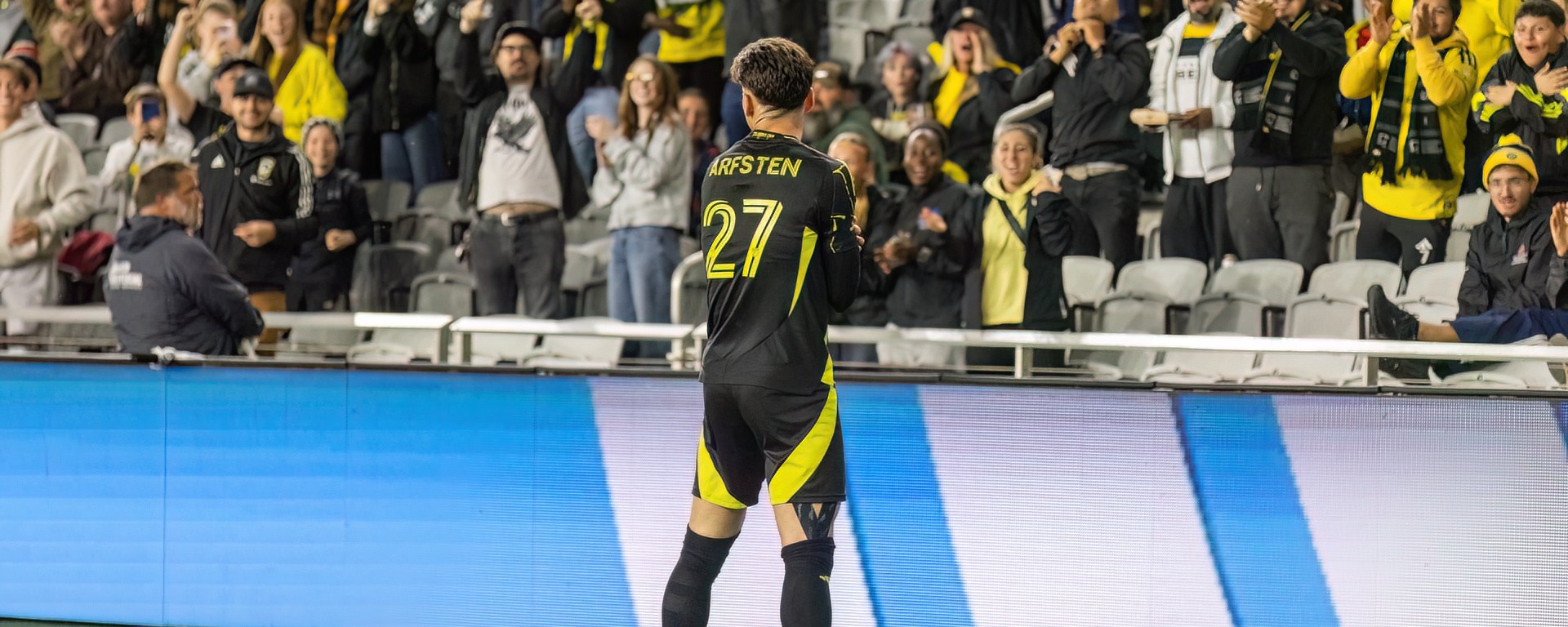
The Columbus Crew returned to midweek action mere days after firing head coach Henrik Rydström after a string of poor performances. This time, the Black & Gold clashed with NYCFC with a position in the US Open Cup Semifinals on the line. Interim head coach Laurent Courtois inherited this Columbus squad in time for the Wednesday matchup and transformed them back into an image of how the Crew looked under former head coach Wilfried Nancy. Back in a wingback role, Max Arfsten broke the deadlock in the second half thanks to a perfectly dispatched shot into the far corner. From there, the Black & Gold defense kept a clean sheet to grab the victory and a place in the semifinals.
The transition from Rydström to Courtois was more seamless than many thought. Courtois’ Nancy-like philosophy seemed to resonate with the players, turning in one of the better performances of 2026. Let’s dive into all the tactics that helped the Crew waltz into the final four of the US Open Cup.
A return to old tactics
Right off the bat, it was evident that Courtois intended to go back to the Black & Gold’s bread and butter over the past three years. After Rydström attempted – unsuccessfully – to transition the Crew to a 4-4-2, Courtois brought Columbus back into a more natural 5-2-3 shape.
The backline kept Rudy Camacho in the center, flanked by Steven Moreira on the right and Sean Zawadzki on the left. Arfsten manned the left wingback role with Andres Herrera on the other side. Andres Gomes and Sekou Bangoura held down the middle of the pitch while Diego Rossi, Taha Habroune and Nariman Akhundzada formed the fluid front three.
While some, like Akhundzada, Bangoura and Gomes never played under Nancy, they fit in well alongside the other seasoned veterans of the 5-2-3 system. Transition moments looked more fluid, passes were not forced and the Crew looked much more comfortable compared to recent weeks under Rydström.
This new – or technically old – system had some positional and playstyle caveats that gave Columbus an edge.
Starting off with the Black & Gold’s shape, on defense the Crew remained in a standard 5-2-3 formation that had two phases. When pressing, Columbus pushed with the attacking front three, followed by the wingbacks jumping up on marks to cut off passes down the lines. Gomes and Bangoura stepped on the midfielders available to receive the ball, forcing NYCFC to be patient or play long.
This change in pressure style comes after Rydström installed a highly resisted and hesitant press. After a string of games where the Black & Gold defense looked shotty at best, Coutois decided that the best defense is a good, strong press that makes the opponents uncomfortable. Much like under Nancy, there are solutions and drawbacks, but against NYCFC the press was a resounding success.
The second phase for the Crew’s defense was in deep defending situations. In these moments, Columbus reverted to a 5-2-3 and even 5-4-1 depending on how much pressure NYCFC was putting forth. Given that the visitors finished the game with zero shots on target, the defensive shape worked extremely well.
On the offensive side, the fluid front three found ways to attack NYCFC’s defense in a plethora of ways. The freedom of movement opened up opportunities for Rossi, Akhundzada and Habroune to explore the entire pitch and keep the defense on its toes.
One of the main positional changes in the attack was the play of Habroune. While Rossi and Akhundzada traditionally stayed high to push the backline – with the exception of a few times for Rossi – Habroune dropped deep into the pockets underneath the wingbacks. This pushed Arfsten and Herrera higher and gave Habroune opportunities to get onto the ball and create in midfield.
Outside of the positional changes, the shift in philosophy was also extremely evident. The Crew utilized a number of passages of play to carve through NYCFC’s lines that had more creativity than all the games combined under Rydström.
One staple of this game was the amount of layoff one-twos that Columbus threw out. Often involving Habroune, the young attacker would receive the ball into his feet and lay it off to one of the streaking outside centerbacks. This gave Zawadzki and Moreira a free lane and running head start into the attack.
From there, the Black & Gold set up in their attacking shape of a 1-4-5. Both wingbacks pushed high as wingers, with the midfield now flanked by both outside centerbacks. Only Camacho remained somewhat deep on the halfway line as a safety valve against counter attacks.
In the 1-4-5, the Crew rediscovered how to overload one side of the pitch. Often times, these overloads would grab the defense’s attention and pull them into an overshift, allowing the backside runners to get in on goal.
One final philosophy shift was Columbus’ willingness to soak in pressure and play on the counterattack. Under Rydström, the Black & Gold occasionally looked hesitant to play quickly out of the back, but in this game the Crew flew forward when the opportunity presented itself.
We see this willingness on Arfsten’s goal. The reason Arfsten is open is because the right back is still recovering from the NYCFC attack, leaving Columbus’ wingback in behind the defense with space to create and put a shot on frame.
Questions will be asked if Courtois should remain as the Black & Gold’s permanent manager, but as far as first auditions go, this was a pretty good impression. For a team that currently sits in 13th place in the Eastern Conference, Courtois has a lot of work to do to get the Crew to where they want to be.

