
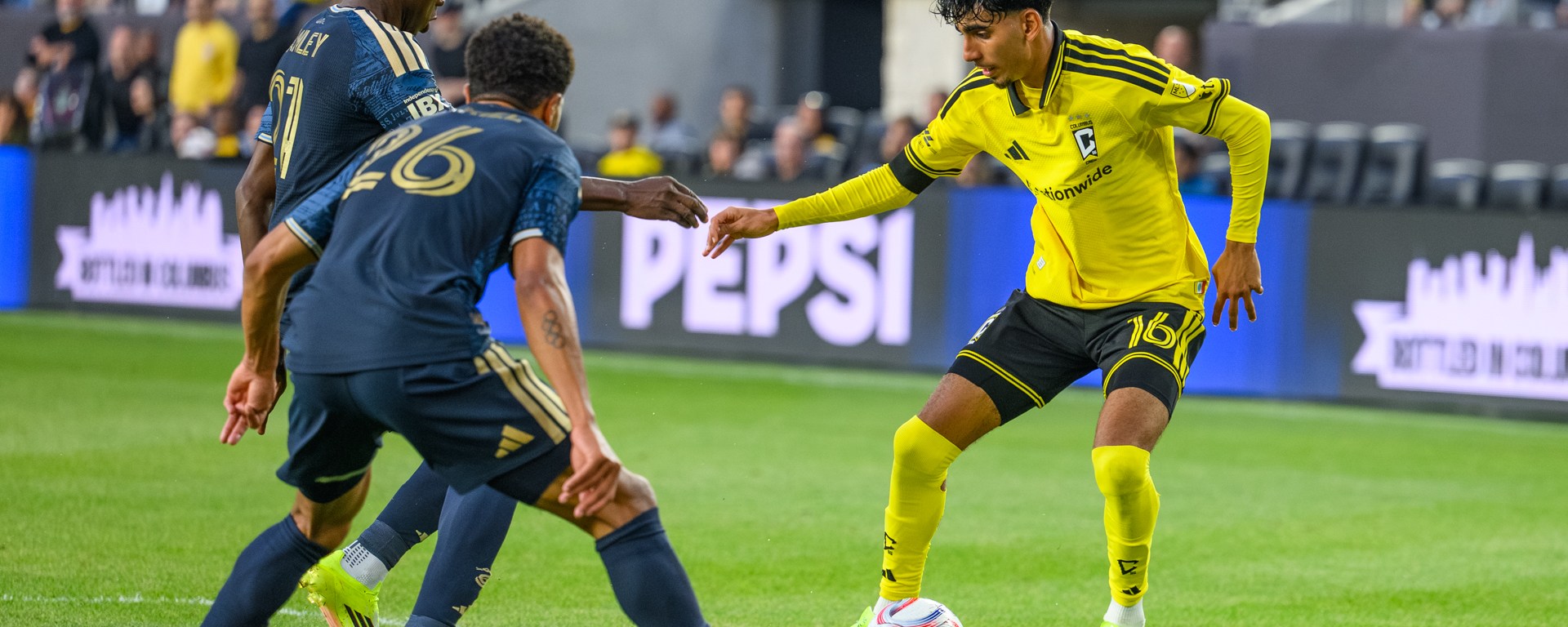
The Columbus Crew capped off a six-point week with a second home win, this time against the Philadelphia Union. After squeaking out a win on Wednesday against the LA Galaxy, the Black & Gold returned home for a second straight game to take on a squad with similar struggles to the Galaxy. It only took Max Arfsten five minutes to open the scoring, beating a defender and sliding the ball past Andre Blake to put the Crew up 1-0. Columbus doubled its advantage right before halftime, pressuring Union defender Nathanial Harriel into a challenge that resulted in an own goal. From there, the Black & Gold cruised. Philadelphia’s ruthless pressure made it difficult at times, but the Crew looked like a completely different team compared to the first few weeks of Henrik Rydstöm’s tenure. After weathering the Union’s pressure, Columbus left with three points to secure two wins in one week for the first time this season.
This game had it all, from electric offense and a chess match of pressure. Let’s dive into all the tactics that ended with the Black & Gold taking the victory.
Countering Philadelphia’s press
There is a reason why Arfsten opened the scoring just minutes into the game. In preparation for the Union’s press, Rydström and his staff had the perfect gameplan to combat the high-intensity defensive scheme.
In comparison to the LA Galaxy’s complete and utter lack of any pressure on Wednesday, the Crew needed a more comprehensive buildup plan for Philadelphia. The Union preferred to press in a 4-4-2 but offset the ball-side winger higher to always press with a front three.
This meant that even when Columbus tried to switch the ball to the opposite fullback, there was another winger there who could continue the pressure alongside the strike partnership, all while the opposite winger could recover.
That was the name of the pressing game for Philadelphia. Employ a high-intensity pressure then recover, and then press again. The only rest the Black & Gold got was when Rudy Camacho or Sean Zawadzki had the ball. The Union engaged the press when possession moved to one of the Crew’s fullbacks.
This compartmental press on each side was accommodated by Philadelphia’s midfielders man marking the Columbus midfielders. Sekou Bangoura typically stayed central, but the keys to breaking the press were actually Taha Habroune and Dylan Chambost.
Due to the Union’s aggressive approach, the Black & Gold had to figure out a way to make their opponents overcommit and then capitalize on that mistake. Habroune and Chambost did exactly that, by pushing high right underneath and inside Arfsten and Picard. When the ball was switched to the near side, the Union fullback jumped up to cut off a ball into Habroune or Chambost’s feet. From there, an easy clipped ball over the top to the streaking winger put the Crew in behind the defense and bearing down on goal.
This is the reason why Columbus had so many strong attacking movements in the opening phase of the game. Chambost and Habroune simply baited the defense into stepping up, then support as late-arriving runners when the ball went over the top to the wingers.
To Philadelphia’s credit, the Union were able to adjust. After the initial rush of chances, Philadelphia’s fullbacks stayed home to cover the runs over the top. There will still chances in behind due to the nature of the Union’s high defensive line, but at least now there was a fullback there to go stride-for-stride with the Crew’s wingers.
On the flip side, Philadelphia’s adjustment opened up avenues in the center of the pitch for the Black & Gold to find with their midfielders and false no. 9s. These were the moments in the game when Habroune shined, showcasing his creative ability and technical skill to dance through the defense.
The Union came into this game hellbent on making the Crew uncomfortable, generating turnovers and living on the counter. To Rydström’s credit, the Columbus coaching staff had the Black & Gold well prepared for everything Philadelphia threw at them.
What we know now about Rydström’s system and how players fit into it
Now that the Crew are ten games into the 2026 MLS season, fans have gotten a glimpse into how Rydström ideally wants his team to operate. After a rough opening stretch, the past two games showcased just how good this Columbus team can be.
Beginning the first few matches in a familiar 5-2-3, the coaching staff made the switch to a 4-4-2 in the fourth game of the season against Nashville. The match ended in a 1-0 loss, but there were sparks of life from the Black & Gold, even in a new formation.
Now six games later, we can see which players fit into the roles of a 4-4-2 and how Rydström expects them to play.
Starting with the tactics, the Crew want to control the ball – as has been their style for nearly the last decade and a half – and apply well-timed pressure at certain points. There are slight tweaks on both sides of the ball stylistically from how Columbus played under Wilfried Nancy. On offense, the Black & Gold are now a bit more set positionally as opposed to Nancy’s free-flowing offense. On defense, the Crew do not press nearly as high or as hard as they did under the previous coaching staff.
As for the players, a few have seen their roles change, but not in drastic fashion.
Switching from a 5-2-3 to a 4-4-2, there was a natural progression to move Arfsten and Herrera from a wingback to a winger. Both will do pretty much the same thing on offense in either position, but now as a winger they do not have to defend nearly as much.
The other big change is on the defense. Steven Moreira moves back out to fullback – his position when he first arrived in Columbus under Caleb Porter – along with Malte Amundsen, with Zawadzki and Camacho operating as the centerback pairing.
This has been the biggest change for the Black & Gold. Defending with four in the back compared to three or five is a big difference. The gaps, coverage areas and interchanges are completely different, which was evident with the defense’s struggles throughout the first part of the season.
In the past two games though, the defense has looked much improved to the tune of one goal conceded in 180+ minutes of gametime.
As for newcomers and others finding their footing, this week represented a coming-out party for Bangoura and Daniel Gazdag.
Gazdag shined on Wednesday, netting a goal and becoming an integral part in the Crew’s buildup as a false no. 9. Once seemingly resigned to the bench during the first stretch of the season, Rydström and his staff will be hoping the Hungarian can regain his Philadelphia-era form in the absence of Wessam Abou Ali.
As for Bangoura, his first appearance in the starting lineup appeared to be a success. The newcomer is a natural ball-winning engine in the middle of the pitch. At times he can get out of position in his zeal to win the ball back, but he has filled in nicely alongside Chambost in Andre Gomes’ absence.
As always, this week will be taken with a grain of salt looking at the respective league standing positions of the LA Galaxy and Philadelphia Union, but these are the games Columbus must win. If the Black & Gold can build momentum, Rydström may be on the upswing.

