

The Columbus Crew came back from a 1-0 deficit against New York City FC to secure a 1-1 draw at Lower.com Field thanks to a goal from midfielder Sean Zawadzki in stoppage time. It was a heated affair between the Black & Gold and New York City, capped by Cucho Hernandez and Wilfried Nancy’s red cards that left Columbus without its star striker and head coach for portions of the second half.
While a point at home is not the desired result, the Crew kept the team’s unbeaten streak alive with the draw but has now tied the past two games to teams in the bottom three spots in the Eastern Conference. The Black & Gold certainly will want to turn this draws into wins quickly.
Not much changed tactically since these two sides faced off on June 17, but let’s dive into what Columbus did to at least get a point once again.
Offensive setup and strategy
True to form, the Crew lined up in a 3-2-1-2-2 with Darlington Nagbe as the lone central midfielder. Nancy opted to go back to the makeshift backline comprised of Malte Amundsen, Steven Moreira and Zawadzki. Hernandez and Christian Ramirez started up top in front of playmaking midfielders Lucas Zelarayan and Alexandru Matan.
As they did in the first meeting with NYCFC, the Black & Gold worked hard to find both No. 10s in the half spaces on the sides of the field. Zelarayan and Matan shifted and dropped into almost a half-pivot position to receive the ball and build from there. Hernandez often checked to the ball to fill the vacated space and give Ramirez room to roam up top.
Columbus’ attack formed an offset formation to cater to the abilities of the attacking midfielders. On the right side, wing back Mohamed Farsi pushed up the field and left space for Zwadzki to slide into. Matan dropped into the half-pivot space between Moreira and Zawadzki and tried to get the ball to his feet. This meant the Cerw had a numerical overload on the right side for the Romanian midfielder to combine with players and build through quick passing.
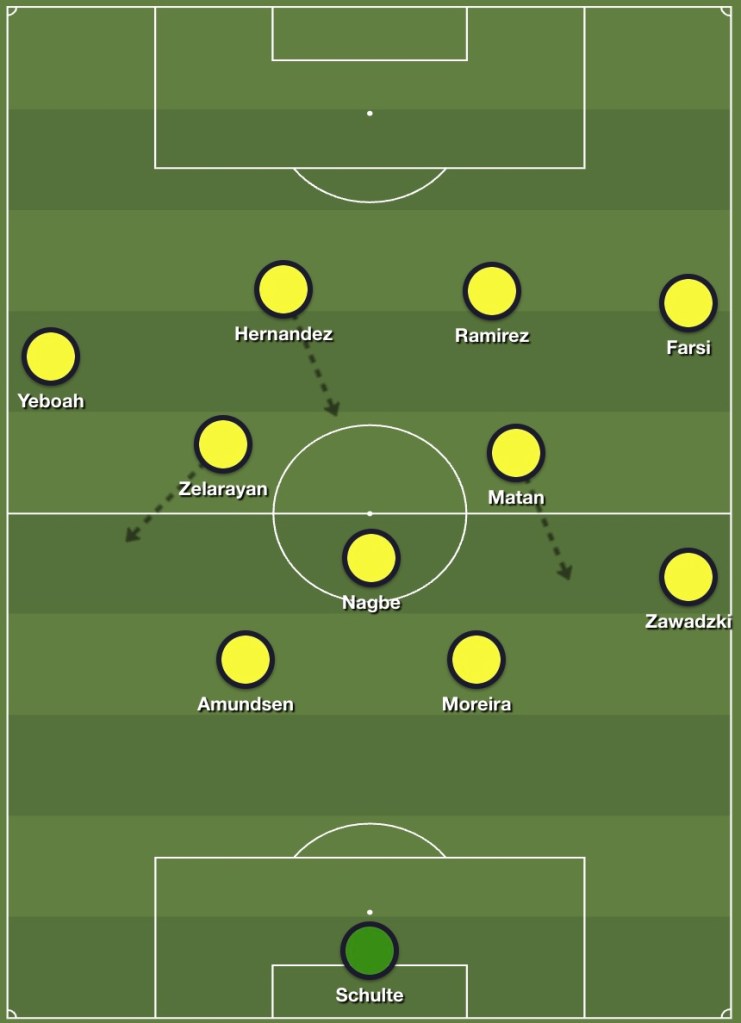
On the other side of the field, Amundsen slid further infield towards Moreira, like a second center back in a back four. Wing back Yaw Yeboah pushed up, leaving Zelarayan acres of space to receive the ball and take on players. Yeboah, Amundsen, Nagbe and a dropping Hernandez were support options, but the Armenian international often wanted to take players on himself.
Once the build up worked the ball into the attacking half, the focus was to get the ball into the penalty box from the half spaces occupied by Zelarayan and Matan. This is where having a poacher and aerial threat like Ramirez was key. That space between the winger and the midfielders is one of the most dangerous chance-creating spaces in the attacking half. Players have the choice of going towards the end line for a cross or foul, cutting inside for a curler (a Zelarayan’s specialty), crossing it directly inside or trying to quickly combine to free up a player for a chance.
Getting the dangerous players in these spaces and tweaking the formation slightly is what created the quality chances for Columbus going forward.
Defensive setup and strategy
The Crew once again lined up in a five/three-back system with wing backs that ran the length of the pitch. Early in the game though, it was the Black & Gold’s pressing that turned defense into offense at a high rate, but also acted later as a double-edged sword.
It’s no mystery that Nancy’s teams want to press high and win the ball back quickly. This prompts a high backline and a tendency to frustrate opponents who can’t figure out how to break out.
This was the case in the first 20 minutes of the game. Columbus had most of the ball and put City under considerable pressure. When the visitors did win the ball back, the Pigeons lost it almost as quickly due to solid counter pressing from the Crew.
As soon as an attacker checked to the ball, a Black & Gold player had his eyes on him. When the pass was played, the defender came in to break up the play and regift possession to Columbus. This pressing strategy was what gave the Crew an initial foothold in this game, but the team failed to capitalize on the dominance before the vigor of the press faded.
NYCFC also adjusted. Instead of playing the ball to the dropping attacker, the visitors tried to take the space available to go forward and find the midfielders. From there, the Crew defense jumped to try and press which opened passing lanes. The Pigeons also began making twisting blindside runs which torched the Black & Gold’s backline. Luckily for Columbus, goalkeeper Patrick Shulte had a monster performance and kept City from scoring much more.
As the game opened up though, the Crew’s weakness became more clear: diagonal balls over the top. Playing with no true center backs has offensive benefits with players that are calmer on the ball, quicker and can make better attacking runs if needed. The downside, however, is these players don’t have the aerial ability of a Milos Degenek or Gustavo Vallecilla. This meant that diagonal balls in the air were difficult to defend and led to goalscoring chances for NYCFC.
Other than those few things, the Black & Gold defended well enough. There is definitely room for improvement, but with Degenek and others coming back healthy, it will be interesting to see what Nancy’s preference is personnel wise going forward.
 MASSIVE REPORT
One thought on “Crew tactical review: Black & Gold secure late point against New York City FC”