
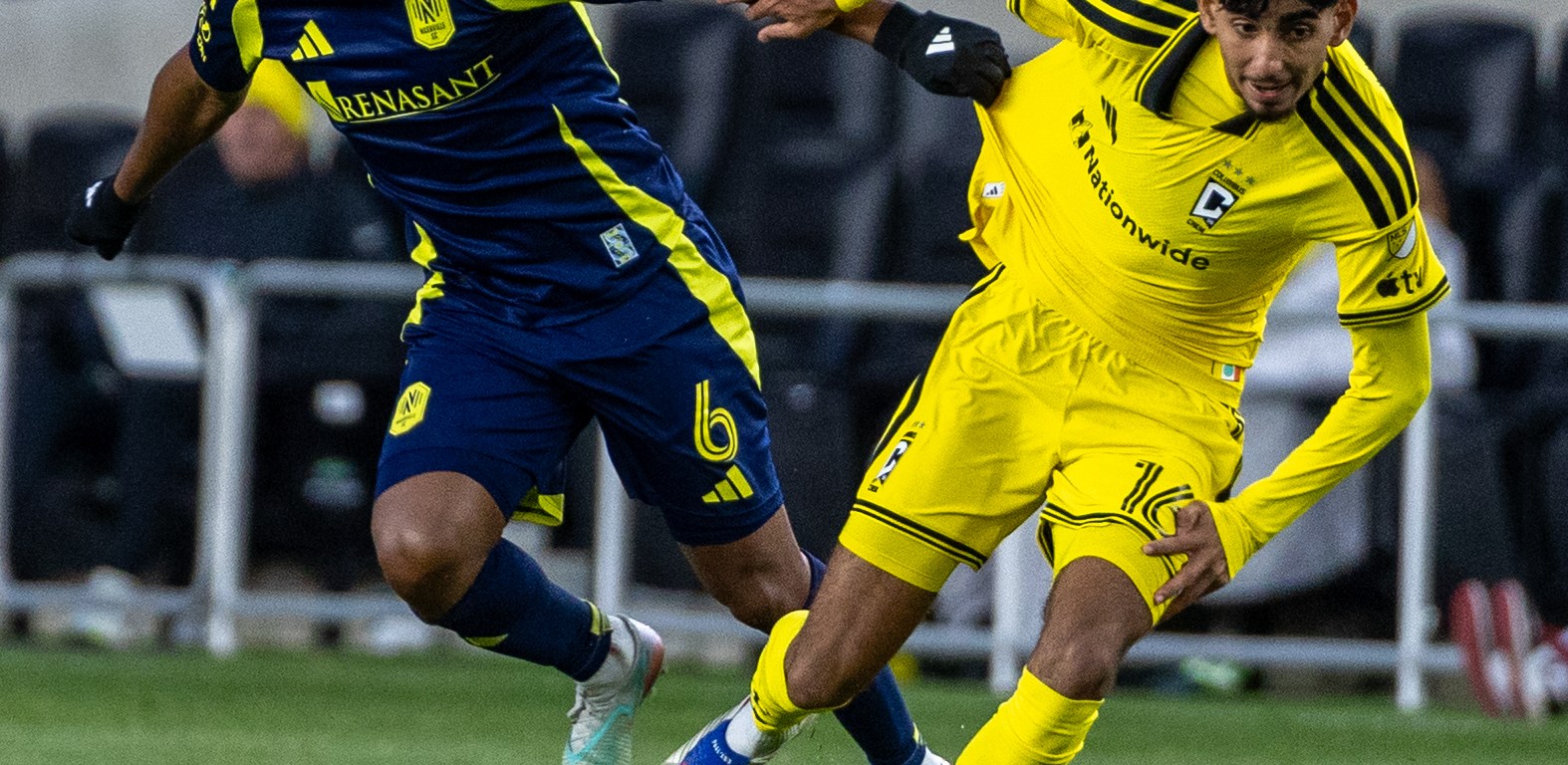
The Columbus Crew continued its winless start to the 2026 season on Saturday, this time dropping a late winner to Nashville SC at home. Facing a heavily rotated away side, the Black & Gold looked promising going forward, even breaking through in the first half courtesy of Taha Habroune pouncing on a rebound. Unfortunately for the Crew faithful, the goal would be called back for offsides and Columbus would not find the back of the net for the rest of the match. Still, the Black & Gold had plenty of moments going forward but were unable to find that final killer touch to get on the scoreboard. Nashville, on the other hand, reloaded in the second half. The visitors subbed on many of their regular starters to make a push for all three points, which was ultimately rewarded when Hany Mukhtar broke the deadlock in stoppage time. By that time, it was too late for the Crew to mount any kind of late-game heroics, falling 1-0 at home.
This game featured a completely new formational look that fans in Columbus had not seen in years, yet it still did not yield a result. Let’s dive into all the tactics that played into this matchup against Nashville.
Back to the future: the return of the four-back
It has been a long time since fans of the Black & Gold saw their team line up in a four-back formation. One would need to think back to the days of Caleb Porter before his firing in 2022 to recall a traditional 4-2-3-1 formation.
On Saturday against Nashville though, Henrik Rydström continued to tweak his tactics, marking the first return of a base four-back formation in nearly four years.
The Crew set up in a base 4-4-2. Steven Moreira and Rudy Camacho were the center backs, flanked by Malte Amundsen and Andres Herrera. In midfield, newcomer Andres Gomes and Sean Zawadski played as double no. 6s, with Diego Rossi and Max Arfsten on the wings. Habroune and Wessam Abou Ali formed the striker partnership.
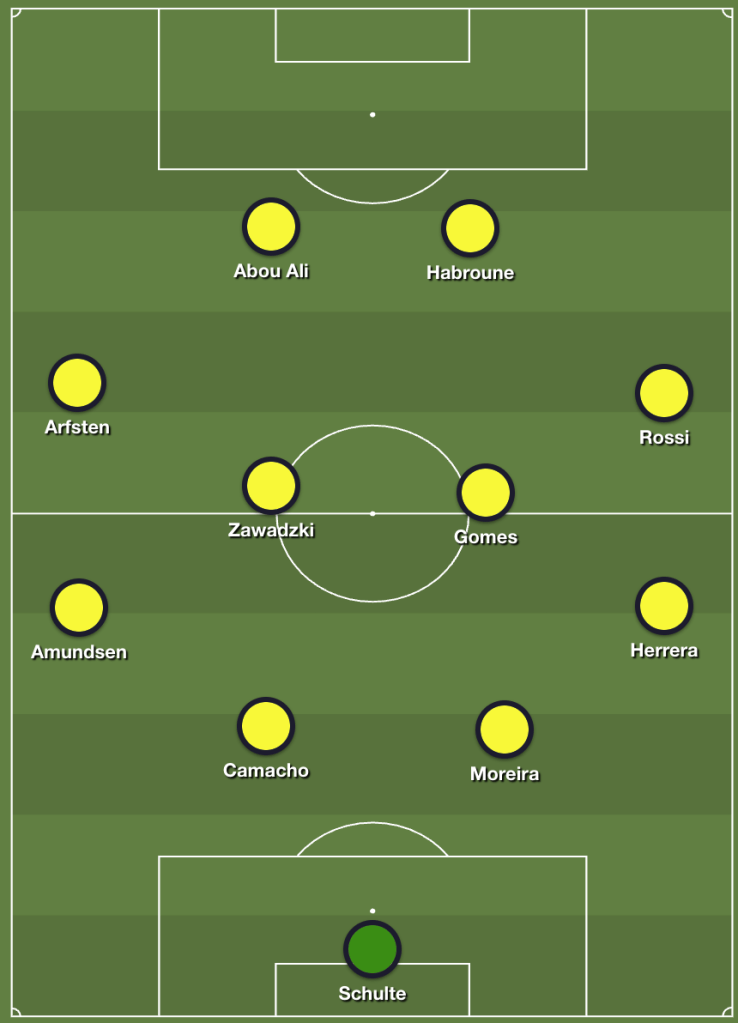
Much like Wilfried Nancy’s system, despite the change in formation, the Black & Gold could morph their shape depending on the situation in the game. On defense, the Crew stuck with the 4-4-2, having defensive stability with Rossi, Arfsten, and sometimes Habroune dropping back to help.
In transition and deep possession scenarios, Columbus moved into a 4-2-4. This was a simple switch, with Rossi and Arfsten moving up alongside the strikers to give the Black & Gold a front four. That 4-2-4 could become a 2-2-6 when the Crew moved into the attacking third. Both Rossi and Arfsten pinched into the center of the field, allowing Herrera and Amundsen to overlap.
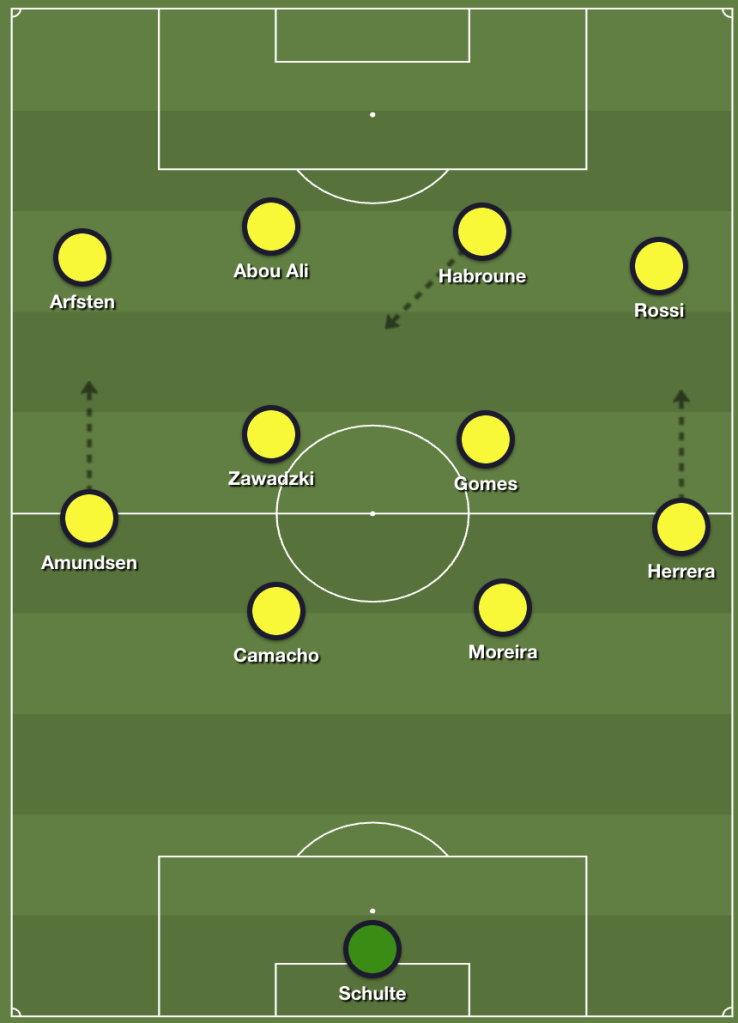
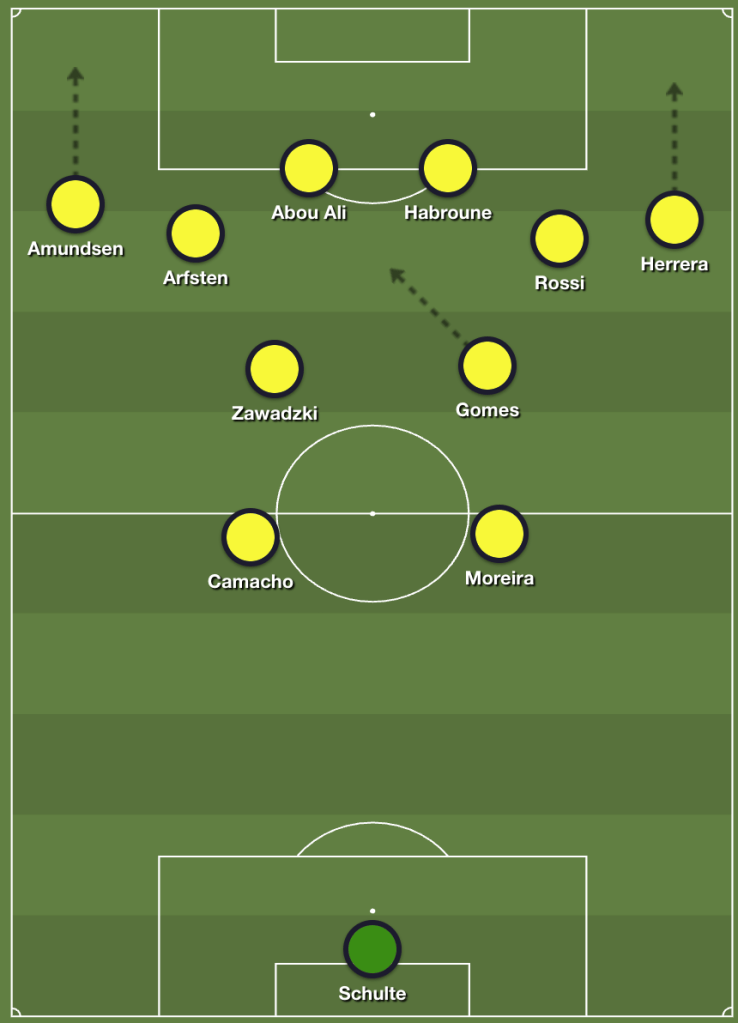
This change from a five-back system to a four-back system switched up a few things for Columbus. First, it gave the Black & Gold consistent width with a set of outside backs and midfielders. In the 5-2-3, sometimes the front three could become too narrow in the press, which gave opponents more space down the flank to exploit. Second, it gave the Crew stability in the back with an extra player next to Camacho while Columbus was in the opposing attacking third. Rydström has made a concerted effort over the past two games to shore up the defense after collapses in the back, so having Moreira and Camacho as the first line of transition defense helps that effort.
Finally, it moves the Black & Gold more towards Rydström’s vision for the team. The new manager still has fluidity when it comes to his tactics and formations but has preferred to use a four-back formation in the past. This past game against Nashville is just another step in the direction that Rydström wants to mold this team.
Still, four games in and not a win to show for is not good results to start off his tenure. Rydström will be hoping that the results will come along with the player’s understanding of his specific tactics as Columbus transfers from Nancy into this new era.
Where is the disconnect?
Through the first four games of this season, the Black & Gold have not looked like the machine they once were. The defense has holes, the midfield no longer dictates tempo and the offense has struggled out of the gate, but where was the issue in this game against Nashville?
The answer lies up top, with Abou Ali. The Crew have long been a team built around the play of DPs. Guillermo Barros Schelotto, Federico Higuain, Lucas Zelarayan, Cucho Hernandez and now Abou Ali were all brought in to be the signings to put Columbus over the top. All of those names – except Abou Ali so far early into his Crew tenure – have fulfilled that role in leading the Black & Gold to new heights.
Granted, every single one of those players is not alike. They had different coaches, systems, teammates, playstyles and even business metrics, but all of them were the central cog in the Columbus machine on the pitch.
So far this season, Abou Ali has not been involved enough in games to make a difference for the Crew, but it is not entirely his fault.
Teaming up with Rossi posed an interesting tandem to begin the year. The thought was that Rossi would be the facilitator to Abou Ali’s immense finishing ability, and the two would combine to be the tip of Columbus’ attacking spear. That ability was on full display in the first match against Portland, but since then has gone a bit cold.
For the Black & Gold to be successful on offense, Rossi and Abou Ali both have to take on the roles of facilitator and poacher. Resigning one or the other to just one of those slots tips off the defense on how to set up against them, which has not worked well so far.
Through the first part of this season, Abou Ali’s role has been primarily to stretch the defense and be the last step in the Crew’s attack. Rossi, Habroune, Arfsten and others do the work to get Abou Ali the ball, in which he is expected to finish. That approach is not sustainable – evident through the results of the first four games.
If Columbus wants to kick its offense into hyperdrive and start winning games, the Black & Gold need Abou Ali to be more involved in the buildup. Where he goes, defenders follow, which then opens up space for other attacking pieces to exploit.
Again, not all of this is Abou Ali’s fault. Often times, he drops into midfield or finds a pocket of space to receive the ball to his feet, but the pass does not come from his teammates. The Palestinian needs to be involved in every aspect of the Crew’s game as an equalizer to make everyone around him better.
It is also worth mentioning, Daniel Gazdag returning to his form in Philadelphia would certainly take some pressure off the other Columbus attackers, but that seems like a distant wish for many fans of the Black & Gold.
If the Crew want to start racking up points, they need to do it through their main man up top. Gone are the days of simple poachers, especially in Rydström’s system. Columbus and Abou Ali need to work together and figure out how to unlock his full potential outside of just being a goalscorer. If they can do that, this season can turn around in a flash for the Black & Gold.
 MASSIVE REPORT
I’ve been hoping they woukd switch to a 4-4-2 or 3-5-2 but they are using players wrong and I think they may only have 9/10 pieces. This system is all about creating triangles and overloads, but we aren’t putting the players in complementary positions. Abou Ali and Rossi need to be the 2 so they can play off each other. Rossi is not a crosser so putting him on a wing makes no sense. He is at his best with those quick give and go runs in tight space. I like Afsten and Amundson for overlaps on the left. I would push Herrera forward on the right where they had Rossi and kick Moreira back out to RB to allow him to be more involved in the buildup. Keeping Moreira as a CB in a 2 CB formation limits his strength of going forward. That gives you a solid overlap out right and crossing opportunities. Abou Ali should be getting more direct cross opportunities to finish. I would also allow Arfsten and Herrara to switch sides periodically to keep the defense guessing. Now drop Zawadski into the CB pairing with Camacho. This allows Zawadski to play to his strengths and be able to interchange with Gomes in the buildups. Gomes looked in good form as a possession/holding midfielder but they need someone who is going to push play forward beside him. I’m not sure they have this player. Habroune isn’t ready to be a starter. His poor first touches, giveaway passes, and dribbling into defenders cancel out his pretty solid work rate. Chambost seems more like the backup to Gomes. I would think outside the box first and try Gazdag in that role to see if dropping him back and allowing him to work in a triangle with Abou Ali and Rossi gets him back in a playable form. If not then they need drop Rossi into that role and rotate the new players in up front for now and look for that player in the next widow.
LikeLike